Rollable Ribbon vs Loose Tube Fiber Cable: Which Is Better for High-Density Data Center Backbones?
Neither rollable ribbon nor loose tube fiber cable is universally better. For high-density data center backbones, rollable ribbon becomes attractive when very large fiber counts must fit into limited ducts, trays or pathways and when mass fusion can reduce repetitive splice cycles. Loose tube can be the better operational choice when fiber counts are lower, technicians need frequent individual-fiber access, or existing tools, closures and procedures are built around single-fiber work.
The decision should follow the dominant project constraint: fiber count, pathway capacity, splice volume, access requirements, field tooling, maintenance model and future expansion. Cable technology should not be selected simply because one architecture sounds newer.
This comparison builds on JHT NetFiber’s guide to high-density fiber requirements in AI data centers. That article explains why density matters; this one helps engineers and procurement teams choose between two cable architectures.
Rollable Ribbon vs Loose Tube: The Short Answer
| Project requirement | Rollable ribbon | Loose tube |
|---|---|---|
| Very high fiber count | Strong fit when density and bulk splicing are priorities | Possible, but cable size and splice workload depend on design |
| Limited duct or tray capacity | Strong candidate | Evaluate actual OD and fill |
| Mass fusion splicing | Designed for compatible ribbon workflows | Usually single-fiber; fibers can be ribbonized in some workflows |
| Individual fiber access | Possible with the correct design and procedure | Often simpler and more familiar |
| Frequent mid-span access | Project-dependent | Often the more familiar workflow |
| Very large backbone splice points | Can reduce fusion-cycle count | More individual splice operations |
| Low fiber-count links | Often unnecessary | Strong fit |
| Existing single-fiber field workflow | Requires tooling and training review | Strong fit |
A data center campus with congested conduits and thousands of fibers converging at a few planned splice locations presents a different problem from a distributed network with frequent branches and incremental turn-up. Procurement should compare the complete route and operating workflow, not only the cable datasheet.
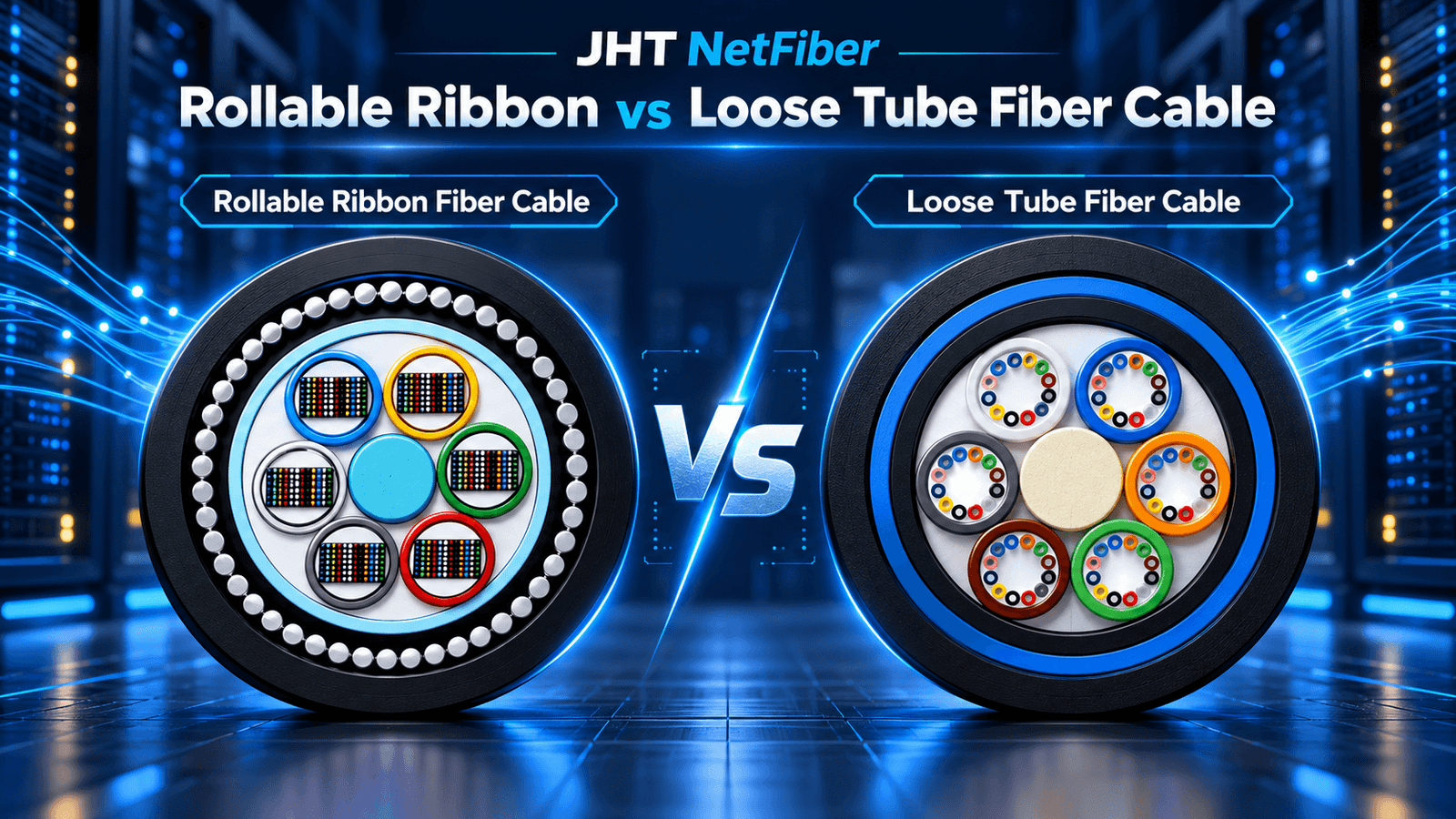
How Rollable Ribbon and Loose Tube Are Structurally Different
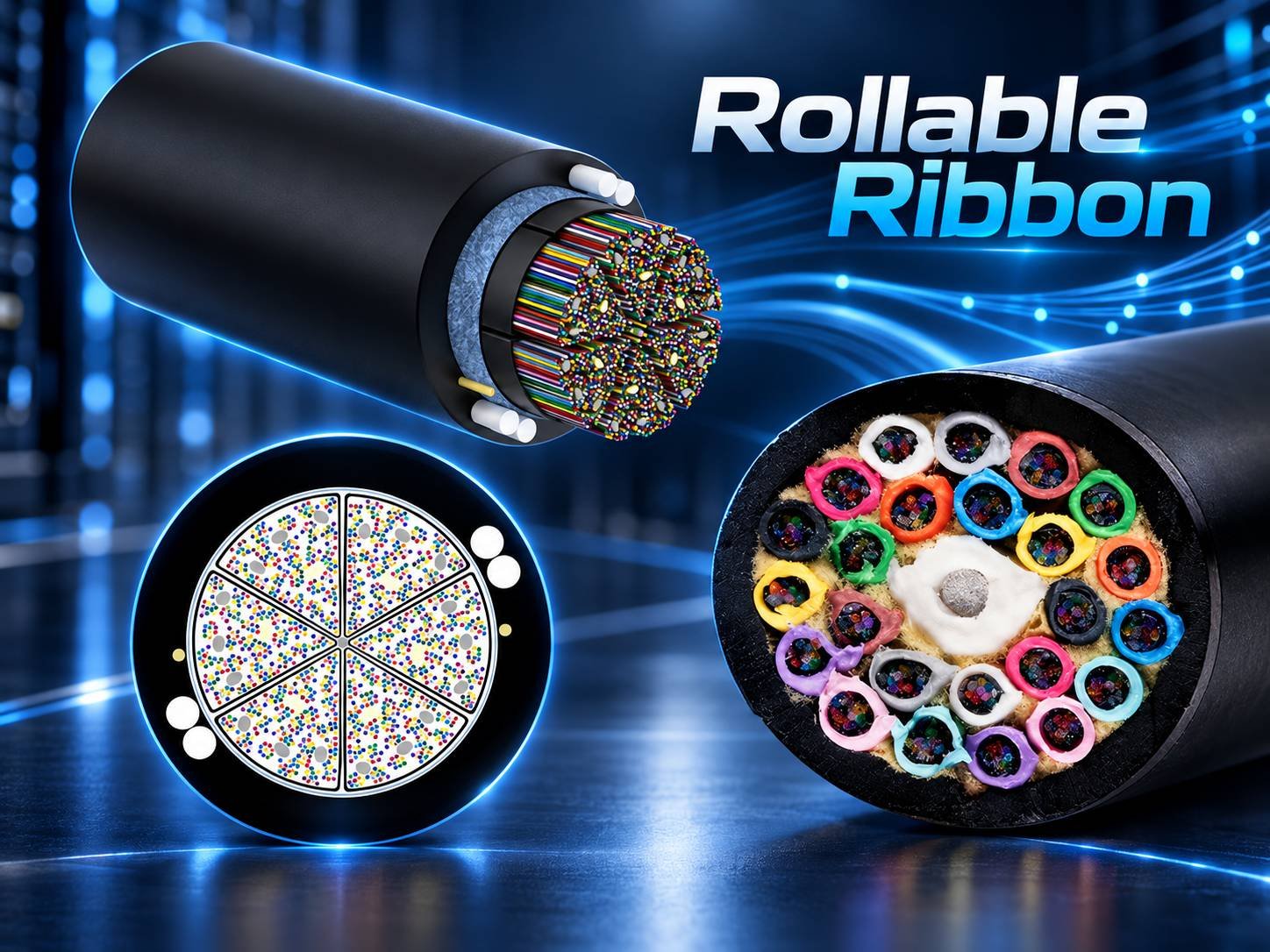
Loose tube cable places individual fibers or fiber bundles inside protective tubes. The tube architecture provides controlled excess fiber length and helps isolate fibers from some mechanical stresses. Field teams often know how to open the selected tube, identify individual fibers, route service loops and perform single-fiber splicing.
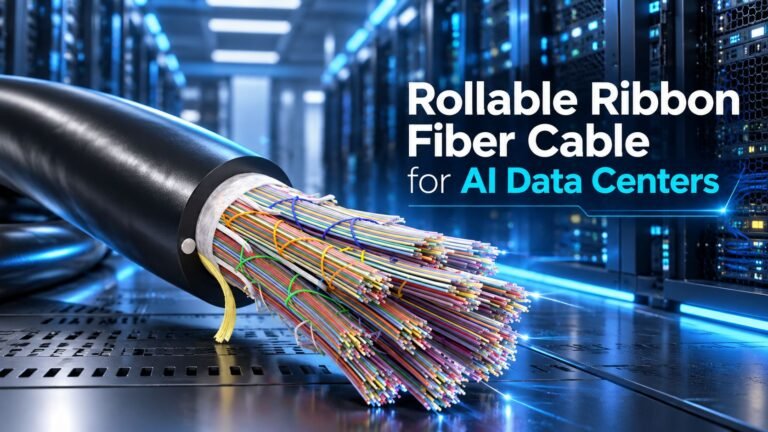
Rollable ribbon cable organizes fibers into flexible ribbon groups. Adjacent fibers are joined at intermittent or partial bonding points rather than being continuously encapsulated in a rigid flat matrix. The ribbon can conform inside a compact cable core and then be organized into an ordered unit for compatible mass fusion splicing.
Not all loose tube cables and not all rollable ribbon cables use identical constructions. Tube count, fiber coating diameter, ribbon pattern, strength members, water blocking, jacket, armor and fire rating all affect the final cable. The International Telecommunication Union describes partially bonded ribbon and its mass-splicing intent in ITU-T L.101.
Why Fiber Density Changes the Decision
Fiber count is the number of fibers in a cable. Fiber density is better understood as the number of usable fibers relative to cable cross-sectional area or occupied pathway space. Two cables with the same count can place very different demands on a conduit, tray, reel, bend or entrance facility.
Density becomes important when existing conduit cannot be expanded, overhead tray space is limited, campus ducts are congested or future AI halls need reserved backbone capacity. A high-count cable is not automatically the densest option; the engineering comparison requires actual OD, route geometry and installation limits from approved drawings.
Engineering insight: The right question is not “How many fibers fit in the cable?” It is “How many usable, identifiable and maintainable fibers fit in the available pathway and splice-management system?”
Cable Diameter and Pathway Utilization
An optimized rollable-ribbon design can provide a smaller outside diameter for the same fiber count, or more fibers within the same pathway, depending on the complete construction. This potential is why rollable ribbon is frequently evaluated for dense campus and data hall backbones.
The route still controls the result. Record duct inner diameter, existing occupancy, tray fill, bends, pull points, pulling space, minimum bend radius and service-loop locations. A smaller cable may improve conduit utilization but can still require careful bend control, compatible pulling equipment and large splice-management capacity.
Do not apply a universal cable-size or pathway-capacity percentage. Armor, water blocking, strength members, jacket and fire-rating construction can change both OD and mass. Compare the exact JHT NetFiber drawing proposed for the project against the alternative loose tube construction.
Splicing: Mass Fusion vs Single-Fiber Workflow
Loose tube projects commonly use individual fiber preparation, cleaving and fusion. Rollable ribbon can present an organized ribbon unit to a compatible mass-fusion system. Mass fusion can reduce the number of fusion cycles when many fibers must be joined at the same splice point.
It does not make the whole project 12 or 16 times faster. Total labor also includes cable opening, ribbon or fiber preparation, cleaning, cleaving, loading, splice protection, tray routing, identification, inspection, testing, documentation and rework. Crew familiarity can change the outcome substantially.
The Fiber Optic Association distinguishes single-fiber and ribbon fusion in its fusion-splicing reference. Before procurement, confirm fiber coating diameter, ribbon pitch, holders, stripper, cleaver, fusion splicer, sleeves and tray system. Twelve- and sixteen-fiber workflows require matching equipment; not every rollable ribbon uses either format.
What Happens When Only One Fiber Needs Repair?
A single fiber fault does not automatically require replacing the entire cable. Repair may involve accessing and separating the affected fiber, performing a controlled single-fiber splice, or re-splicing an affected ribbon section. The correct method depends on ribbon construction, closure, spare length, protection method, available tools and technician experience.
The important operational question is how the selected cable is intended to be restored. Ask the supplier for the approved access and repair procedure, then confirm that the installed closure provides enough working length, bend control and protected storage for both ribbon units and any separated fibers.
Engineering insight: Procurement teams should ask not only “How fast can we install it?” but also “How will technicians repair or modify it five years later?”
Mid-Span Access: Where Loose Tube May Have an Advantage
Loose tube is often more familiar for routes requiring mid-span branching, individual-fiber extraction, small branch distribution or incremental customer turn-up. Technicians can identify a tube, expose selected fibers and leave pass-through tubes stored in the closure when the cable and hardware support that procedure.
Ribbon designs can also support mid-span strategies, but the access method, pass-through ribbon protection and closure layout must be engineered. The FOA’s mid-span access guidance notes that ribbon procedures exist but require ribbon splitting and careful protection.
Do not treat this as an absolute loose-tube advantage. A modern ribbon design with compatible access hardware may work well. The buyer should request the exact field procedure and evaluate it against expected branch frequency and restoration practice.
Splice Trays and Closure Capacity
High fiber count is not only a cable problem. The splice tray, closure, rack enclosure, protector sleeves, fiber routing, bend control, service loops, labels and future access all require capacity. A smaller cable does not automatically create a smaller splice-management system.
If cable density increases but closure and tray design do not, pathway congestion may simply become splice-management congestion. The project should calculate ribbon or fiber units per tray, total splice protectors, pass-through storage, cable-entry capacity, labeling visibility and safe access after later adds, moves and changes.
For data center terminations, the backbone may enter high-density patch panels or transition through cassettes. The enclosure plan must match the selected field-splice or pre-terminated architecture.
Installation and Technician Familiarity
Rollable ribbon can be efficient for repetitive, high-count backbone splicing, but it may require knowledge of ribbon preparation, compatible cleavers and fusion equipment, correct trays and a disciplined identification system. Trial preparation on the approved cable sample is preferable to assuming that every mass-fusion crew uses the same procedure.
Loose tube workflows are widely familiar and use common single-fiber tools. At very high counts, however, individual splice volume and fiber organization can become significant. A familiar process is not automatically the lowest-labor process when thousands of fibers converge at a limited number of splice points.
Installation efficiency is therefore not determined by cable technology alone. Crew training, tooling readiness, route access, test method and closure design belong in the bid evaluation.
Rollable Ribbon vs Loose Tube Comparison
| Engineering factor | Rollable ribbon | Loose tube | What the buyer should check |
|---|---|---|---|
| Fiber density | High potential | Low to high, design-dependent | Actual fiber count, OD and construction |
| Cable diameter potential | Can be smaller for the same count | Varies by tube and core design | Approved drawing, not generic claims |
| Very high fiber counts | Strong candidate | Available in high counts with tradeoffs | Route and splice scale |
| Mass fusion | Native where compatible | Possible after ribbonizing in some workflows | Pitch, holders, tools and procedure |
| Single-fiber access | Possible but procedure-dependent | Often straightforward | Repair and access instructions |
| Mid-span access | Design- and hardware-dependent | Common field workflow | Branch frequency and closure |
| Splice-cycle count | Can reduce fusion cycles | Usually more individual cycles | Total splices at each location |
| Splice tray needs | Ribbon trays and organized mapping | Single-fiber trays and storage | Tray count, protectors and service loops |
| Cable preparation | Ribbon-specific discipline | Tube opening and fiber routing | Crew training and sample trial |
| Field familiarity | Varies by contractor | Often broad | Qualified technicians and equipment |
| Repair workflow | May require deribbonizing or ribbon repair | Often individual-fiber repair | Five-year restoration plan |
| Conduit utilization | Strong density potential | Depends on actual OD | Duct ID, fill, bends and pulling |
| Data center backbone | Strong for dense centralized routes | Strong where access flexibility dominates | Topology and operations model |
| Campus backbone | Strong for high-count trunk routes | Strong for branch-heavy OSP routes | Environment and branching |
| Future expansion | High fiber reserve in constrained pathways | Incremental access can be flexible | Growth forecast and spare strategy |
Where Rollable Ribbon Usually Makes More Sense
These conditions make rollable ribbon worth evaluating; they do not guarantee that every rollable-ribbon design fits. Verify OD, installation environment, pulling method, fire rating, ribbon mapping and closure capacity.
Where Loose Tube May Be the Better Choice
Loose tube is not outdated, and it can support data center or campus backbones effectively. Its value is strongest when operational flexibility and an established field workflow matter more than maximum packing density.
What About 200 μm vs 250 μm Fiber?
The values describe coating diameter, not optical cladding diameter. A 200 μm-class coating can support higher packing density; 250 μm workflows are widely established and appear in both conventional and some high-density constructions. Neither value alone determines optical performance.
Selection depends on cable design, ribbon pitch, stripping and cleaving equipment, holders, splice workflow, connectorization and project standards. Do not assume every rollable-ribbon cable uses 200 μm fiber or every loose-tube cable uses 250 μm fiber.
What About 12-Fiber vs 16-Fiber Ribbon?
Twelve-fiber ribbon is mature and familiar. Sixteen-fiber ribbon can reduce the number of ribbon groups for a given count and align with selected Base-16 physical architectures when equipment supports the pitch and fiber count.
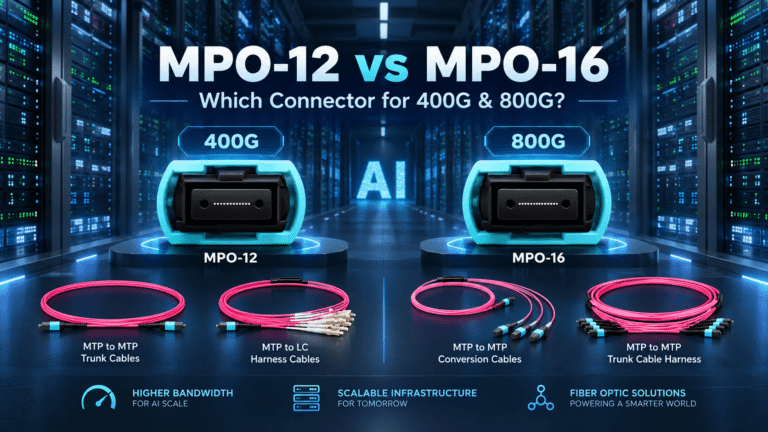
Ribbon count is not an Ethernet-speed rule. A project should not select 16-fiber ribbon merely because it includes 800G optics. The transceiver interface, backbone grouping and splice architecture are related but separate decisions; see MPO-12 vs MPO-16 for 400G and 800G.
Rollable Ribbon and MPO/MTP Are Not the Same Decision
Rollable ribbon is a cable architecture: it determines how fibers are grouped and packaged in the backbone. MPO/MTP is a connector and termination architecture: it determines how fiber groups connect at equipment or patching interfaces.
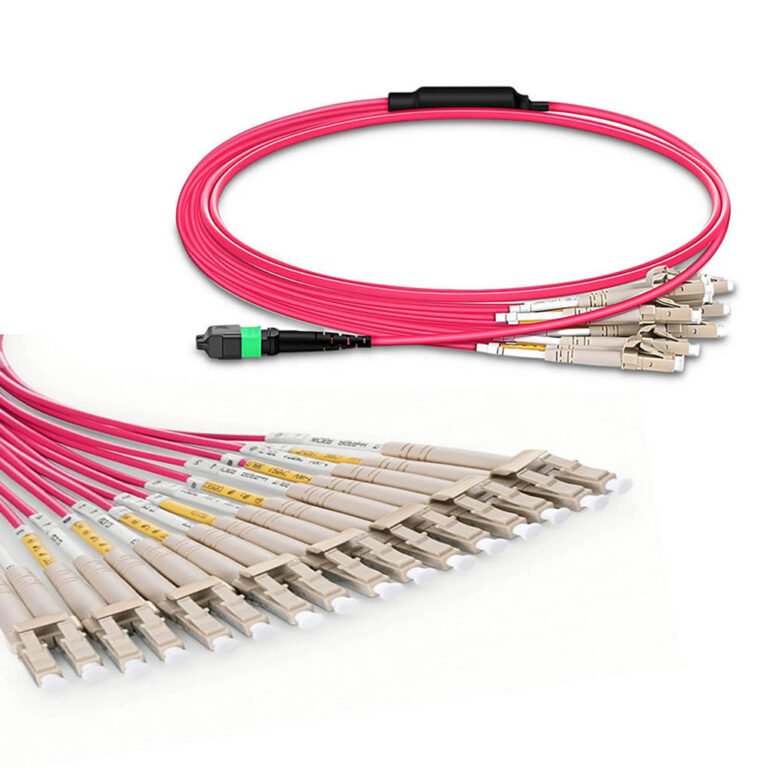
A high-density backbone can be field-spliced, factory pre-terminated, transitioned to MPO/MTP or LC, or landed in cassettes. JHT NetFiber’s MTP/MPO connectivity, breakout cable and fiber patch cord pages describe equipment-side categories, but the final design follows the network architecture.
Pre-Terminated or Field-Spliced?
Field-spliced rollable ribbon often fits very large backbones, long campus routes, custom pulling sections and high counts that converge at planned splice locations. It separates route installation from final termination but requires compatible splicing tools, closures, testing and qualified crews.
Pre-terminated MTP/MPO trunk systems may fit shorter controlled routes, rack-to-rack deployments and projects prioritizing factory termination and rapid plug-and-play installation. Connector protection, pulling access, polarity, loss budget and pathway size must still be checked.
Neither approach is automatically superior. A hybrid design may use field-spliced high-count backbone cable between buildings and pre-terminated assemblies from distribution areas to equipment.
A Practical Selection Framework
If fiber density and bulk splicing dominate the requirements, evaluate rollable ribbon. If frequent individual-fiber access, branching and an established single-fiber workflow dominate, evaluate loose tube.
What Procurement Teams Should Include in an RFQ
Network
Fiber
Cable
Installation
Splicing and Termination
Documentation
JHT NetFiber can use this information to compare cable construction before quotation. Do not release an order until the route, splice architecture and termination interfaces are all represented in the approved drawing.
Frequently Asked Questions
Is rollable ribbon better than loose tube fiber?
Not universally. Rollable ribbon is often stronger for very high counts, constrained pathways and planned mass fusion. Loose tube is often stronger for frequent individual-fiber or mid-span access and established single-fiber workflows. Choose according to the project constraint and maintenance model.
Which cable is better for high fiber counts?
Rollable ribbon is usually a strong candidate because flexible ribbon units can support dense packing and efficient bulk splicing. Loose tube can also carry high counts, but cable OD, fiber organization and splice workload must be compared using actual product drawings.
Can rollable ribbon be mass fusion spliced?
Yes, when ribbon construction, fiber pitch, holders, cleaver and fusion splicer are compatible. Mass fusion reduces fusion-cycle count at large splice points, but preparation, protection, tray routing, inspection, testing and documentation still determine total installation labor.
Can one fiber be repaired in rollable ribbon cable?
Often yes, using an approved access, separation and single-fiber repair procedure or by re-splicing an affected ribbon section. The practical method depends on cable design, closure space, spare length, protection hardware, tools and technician experience.
Is loose tube easier for individual fiber access?
Often, because fibers are managed individually inside identified tubes and many field teams already use that workflow. Access still depends on tube construction, fiber identification, closure design and safe handling. Ribbon can also allow individual access when the design supports separation.
Which cable is better for mid-span access?
Loose tube is frequently the more familiar choice for branch-heavy routes and incremental turn-up. Rollable ribbon can support mid-span strategies with the correct ribbon-splitting method, pass-through protection and closure. Compare the exact access procedure rather than assuming one universal answer.
Does rollable ribbon reduce cable diameter?
It can support a smaller OD for a given fiber count, depending on fiber coating diameter and complete cable construction. Strength members, water blocking, armor, jacket and fire rating also affect size. Compare approved drawings; do not apply a generic reduction percentage.
Does rollable ribbon require special splice equipment?
It requires equipment compatible with the ribbon fiber count, pitch and coating diameter. Verify holders, stripper, cleaver, fusion splicer, sleeves and tray system. Existing equipment may be usable, may require accessories or may not support the proposed construction.
Is rollable ribbon suitable for AI data centers?
Yes when AI backbone fiber counts, pathway constraints and splice concentration justify the architecture. It is not mandatory for every AI facility. Low-count, branch-heavy or frequently accessed routes may favor loose tube or another construction.
Is loose tube suitable for AI data centers?
Yes. Loose tube can be appropriate for campus routes, lower counts, frequent branching, individual access or teams standardized on single-fiber workflows. AI workloads do not automatically determine cable architecture; the physical route and operating plan do.
Should I choose 200 μm or 250 μm fiber?
Choose after comparing density requirements, cable design, splice tools, ribbon pitch, connectorization and project standards. The values describe coating diameter, not cladding diameter. A smaller coating can improve packing density but requires a compatible field ecosystem.
Does 800G require 16-fiber ribbon?
No. Ethernet speed, transceiver interface, backbone ribbon grouping and connector architecture are separate design layers. Confirm both transceiver part numbers, optical lane architecture, patching and splice plan before selecting 12- or 16-fiber ribbon.
Can rollable ribbon connect to MPO/MTP?
Yes through factory termination, fan-out, cassettes or field-spliced pigtails, depending on the design. Ribbon grouping does not automatically equal connector fiber count. Confirm polarity, pinning, polish, mapping, loss budget and test method.
Should high-density fiber cable be pre-terminated or field-spliced?
Use field splicing for large counts, long or custom routes and planned splice points. Consider pre-terminated systems for shorter controlled routes and rapid deployment. A hybrid architecture may combine field-spliced backbone cable with pre-terminated equipment-side assemblies.
Decision Summary
Choose the architecture through this sequence: fiber count → pathway capacity → splice volume → individual-fiber access → mid-span requirements → field tooling → maintenance model → future expansion.
Evaluate rollable ribbon first for very high counts, limited pathways, mass fusion and large backbone routes. Evaluate loose tube first for individual-fiber flexibility, frequent access, branch-heavy routes and established single-fiber field workflows.
Not Sure Which Cable Architecture Fits Your Backbone?
Send JHT NetFiber your required fiber count, route length, duct or tray constraints, installation environment, splice strategy and termination plan. We can review whether rollable ribbon, loose tube or another high-density construction better fits the project before quotation.
Technical References
Technical references checked October 3, 2026. Cable constructions, tooling and field procedures vary; verify the current project specification and supplier documentation before procurement.